


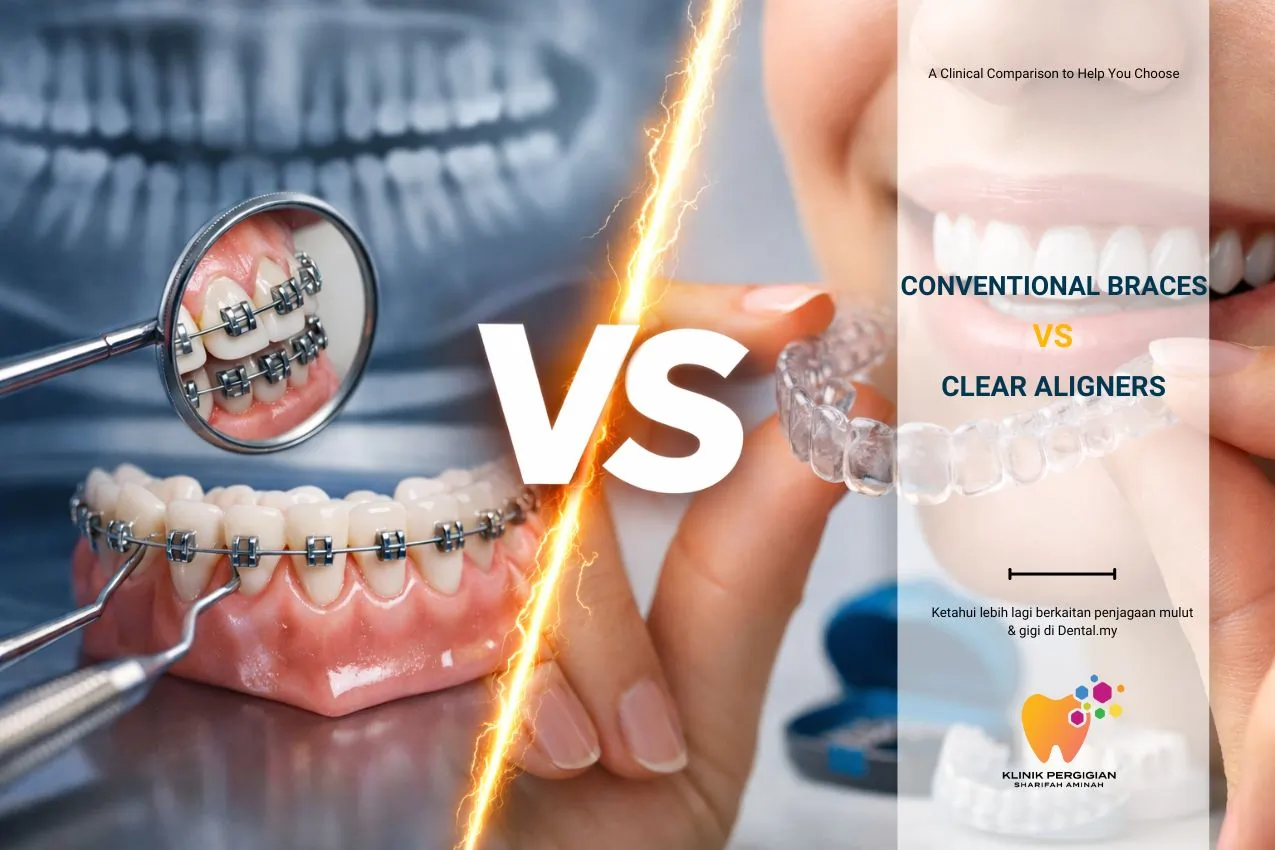

Conventional Braces vs Clear Aligners: A Clinical Comparison to Help You Choose
Orthodontic treatment is not only about improving appearance — it also plays an important role in bite function, oral hygiene, and long-term dental health. In Kuala Lumpur, patients today are commonly choosing between conventional braces and clear aligners as modern orthodontic solutions.
While both treatment options aim to straighten teeth, they differ in approach, suitability, cost, and long-term outcomes. This article provides a clear, evidence-based comparison to help patients make informed orthodontic decisions.
What Are Conventional Braces?
Conventional braces use metal or ceramic brackets and archwires to apply continuous force, gradually moving teeth into the correct position. This system allows Orthodontist or trained general dentist to control tooth movement precisely in three dimensions.
Clinical advantages of conventional braces
- Suitable for mild, moderate, and complex orthodontic cases
- Effective for correcting bite problems such as overbite, underbite, and crossbite
- Less dependent on patient compliance
- Proven long-term stability
Considerations
- More visible compared to aligners
- Oral hygiene requires more effort
- Temporary discomfort during adjustment periods
What Are Clear Aligners?
Clear aligners are custom-made transparent trays designed using digital treatment planning. Each aligner is worn for a set period to gradually move teeth.
Clinical advantages of clear aligners
- Discreet and aesthetic appearance
- Removable for eating and brushing
- Often more comfortable for working adults
Considerations
- Must be worn 20–22 hours daily to be effective
- Limited effectiveness for complex movements
- Treatment success depends heavily on patient discipline
Conventional Braces vs Clear Aligners: Key Differences
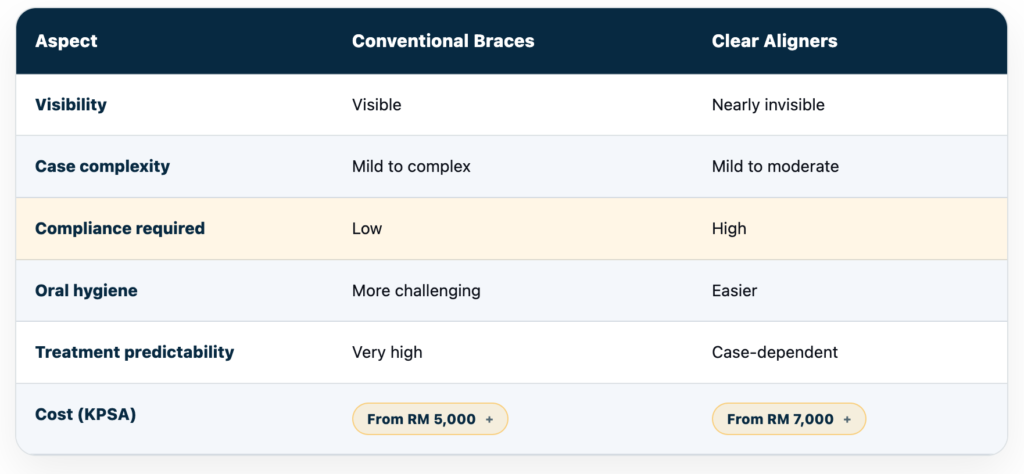
| Aspect | Conventional Braces | Clear Aligners |
|---|---|---|
| Visibility | Visible | Nearly invisible |
| Case complexity | Mild to complex | Mild to moderate |
| Compliance required | Low | High |
| Oral hygiene | More challenging | Easier |
| Treatment predictability | Very high | Case-dependent |
| Cost (KPSA) | From RM 5,000 + | From RM 7,000 + |
A Short Video Explanation Before You Choose

Which Option Is More Effective?
From a clinical perspective, effectiveness depends on the type and severity of the orthodontic problem.
- Patients with significant crowding, rotated teeth, or bite discrepancies often benefit more from conventional braces.
- Patients with mild to moderate alignment issues who can maintain strict wear schedules may be suitable for clear aligners.
“Fixed braces allow orthodontists to control tooth movement in all directions, which is particularly important in complex bite correction cases.” — Professor Emeritus of Orthodontics, University of North Carolina
Supporting clinical data
- Peer‑reviewed orthodontic literature shows that fixed appliances achieve more predictable outcomes for complex movements such as torque control, vertical movement, and rotation.
- Multiple clinical studies report that clear aligners demonstrate approximately 80–90% treatment success in appropriately selected mild to moderate cases, provided aligners are worn for at least 20–22 hours daily.
These findings reinforce the importance of professional diagnosis and case selection, rather than choosing treatment based on appearance alone.
Final Thoughts
Both conventional braces and clear aligners are valuable orthodontic tools when used appropriately. The best choice depends on clinical suitability, lifestyle considerations, and long‑term oral health goals, rather than appearance alone.
A personalised consultation with a qualified dental professional ensures the selected treatment delivers safe, effective, and lasting results.
References
- American Association of Orthodontists (AAO)
- Journal of Orthodontics and Dentofacial Orthopedics
- Clinical Orthodontics and Research
Your Questions Answered
Conventional braces are still widely recommended because they offer better control for complex tooth movement and bite correction. In areas such as Wangsa Maju, Setapak, and Gombak, dentists commonly manage moderate to complex orthodontic cases where fixed braces provide more predictable and stable results.
Clear aligners are effective for mild to moderate alignment issues, but they may be limited in treating complex tooth movement and bite correction. In clinical practice around Wangsa Maju, Setapak, and Gombak, conventional braces are often preferred for cases requiring precise control and long-term stability.
Clinical experience plays an important role in orthodontic treatment planning and execution. Like Klinik Pergigian Sharifah Aminah with over 32 years of experience in providing braces treatment, clinics with long-standing orthodontic exposure are better equipped to manage complex cases, adjust treatment mechanics, and ensure long-term stability.
Orthodontic treatment costs in Kuala Lumpur, including areas like Gombak and Setapak, vary depending on case complexity, treatment duration, and appliance type. Conventional braces generally start from a lower cost range (from RM 5,000 ) while clear aligners may involve higher fees (from RM 7,000) due to digital planning and aligner systems.
Choosing between conventional braces and clear aligners requires a professional dental assessment. Factors such as tooth alignment, bite condition, treatment goals, and long-term maintenance are evaluated before recommending the most suitable orthodontic option.